

Equity Compensation Planning for RSUs, Stock Options and ESPPs
Your company stock can be one of the most valuable parts of your financial life, and one of the most complicated. Restricted stock units, stock options and employee stock purchase plans each follow their own rules for taxes, timing and risk. At JTL Wealth Partners, serving clients in Plano, Southlake and across the Dallas-Fort Worth area, we help you understand what you own, make thoughtful decisions about when to hold and when to sell, and connect your equity to the bigger picture: a confident retirement. Retirement, Simplified.
Understanding Your Equity Awards
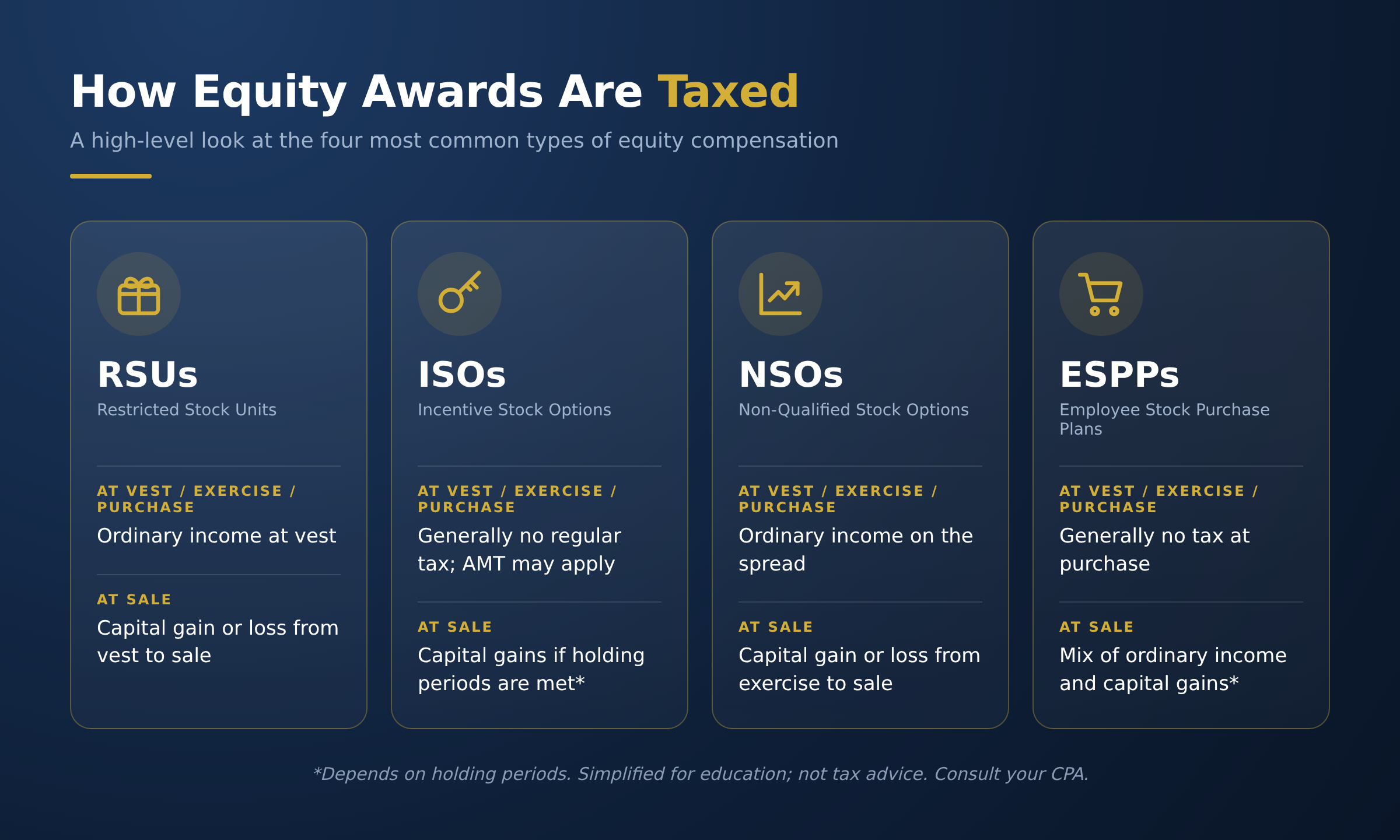
Most equity compensation falls into four categories. Each is taxed differently, so the first step is knowing exactly what you have and what your plan documents say.
Restricted Stock Units (RSUs)
RSUs are company shares you receive as they vest. In general, the value of the shares at vesting is taxed as ordinary income, much like a bonus. Any change in value after vesting is generally treated as a capital gain or loss when you sell. Because companies often withhold at a flat rate, vesting can leave you owing more at tax time than you expect.
Incentive Stock Options (ISOs)
ISOs give you the right to buy company shares at a set price. Exercising ISOs generally does not create regular income tax, but the difference between the exercise price and the market value may count toward the Alternative Minimum Tax (AMT). If you meet certain holding periods, gains at sale may qualify for capital gains treatment; if not, part of the gain may be taxed as ordinary income.
Non-Qualified Stock Options (NSOs)
NSOs also let you buy shares at a set price. When you exercise, the "spread" between the exercise price and the market value is generally taxed as ordinary income. Later growth or decline is generally treated as a capital gain or loss. Because exercising creates taxable income, timing matters.
Employee Stock Purchase Plans (ESPPs)
ESPPs let you buy company stock through payroll, often at a discount. Purchases generally aren't taxed right away. When you sell, the tax treatment depends on how long you held the shares, and may include a mix of ordinary income and capital gains.
Key Planning Decisions
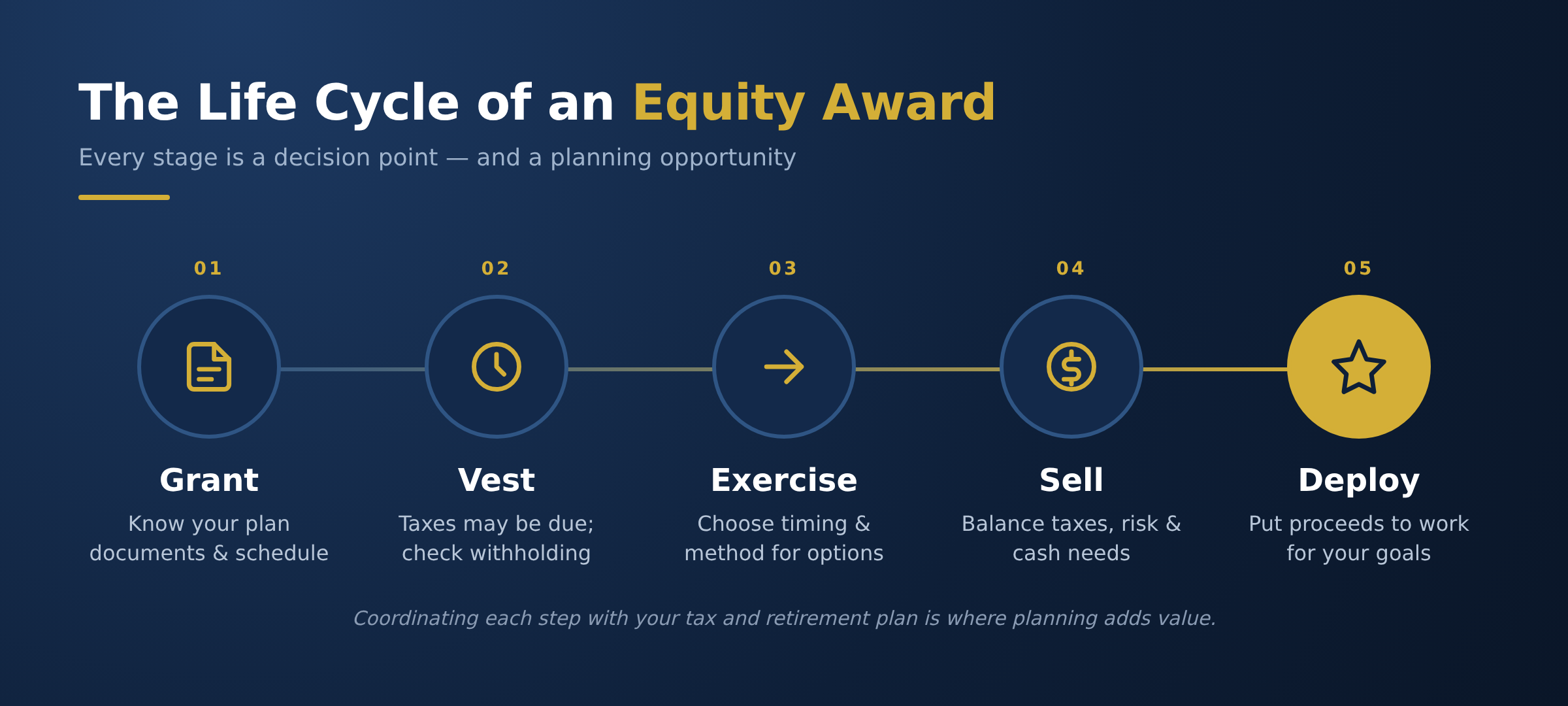
Equity compensation rarely comes with a single right answer. It's a series of decisions made over years, each one affecting your taxes, cash flow and long-term plan.
When to Exercise and When to Sell
Should you exercise options early, spread exercises over several years, or wait? Should you hold vested shares or sell them? We help you weigh taxes, expiration dates, company outlook and your own goals so each decision is intentional rather than rushed.
Managing AMT Exposure
Exercising ISOs can trigger the Alternative Minimum Tax. We work alongside your CPA to model scenarios before you act, so you understand the potential impact and can plan for it.
Concentration Risk and Diversification
When a large share of your net worth, and your paycheck, depends on one company, a downturn can affect both at once. We help you set a thoughtful plan for reducing concentration over time, with attention to the tax cost of selling. For corporate insiders, that can include coordinating sales through a pre-arranged trading plan (Rule 10b5-1) with your company's legal team.
Coordinating With Your Retirement Goals
Your equity should support your plan, not drive it. We look at how proceeds can fund retirement savings, pay down debt, build reserves or support major goals, so your stock becomes part of a clear path to retirement.
Planning for Liquidity Events
An IPO, tender offer, secondary sale or acquisition can turn private shares into cash, sometimes on short notice. We help you prepare ahead of time: understanding your options, the potential tax consequences and how you'll put proceeds to work. For founders and early employees, we can also help you ask your tax professional whether provisions such as the Section 1202 qualified small business stock exclusion may apply.
Charitable and Estate Strategies
Appreciated company stock can be a meaningful tool for giving and for passing wealth to the next generation. Depending on your situation, strategies may include donor-advised funds, charitable trusts or gifting to family. We coordinate these strategies with your CPA and estate planning attorney.

Equity Compensation: What Many People Don't Know
Equity awards come with fine print that can be easy to miss. Here are a few lesser-known rules that may affect what you keep.
Did you know the standard withholding on RSUs may fall short?
Employers often withhold federal tax on vested RSUs at a flat 22% supplemental rate (37% on supplemental wages above $1 million in a year). If your actual tax bracket is higher, you may owe more when you file, and possibly an underpayment penalty. Planning ahead for estimated payments or extra withholding can help you avoid a surprise in April.
Did you know ISOs have two holding periods, not one?
To receive the more favorable tax treatment on ISO shares, you generally must hold them more than one year after exercise and more than two years after the grant date. Selling sooner is a "disqualifying disposition," and part of your gain may be taxed as ordinary income instead. Tracking both dates before you sell may make a meaningful difference.
Did you know there's a $100,000 annual limit on ISOs?
Only the first $100,000 of ISO grants (measured by grant-date value) that become exercisable for the first time in a calendar year can qualify as ISOs. Anything above that is generally treated as non-qualified options, which are taxed differently. Knowing which of your options are which can shape when and how you exercise.
Did you know AMT paid on ISOs may come back to you?
If exercising ISOs triggers the Alternative Minimum Tax, you may be able to claim a minimum tax credit in later years using IRS Form 8801, because AMT from timing items such as ISO exercises can generally be credited against future regular tax. Any unused credit carries forward to later years, but it is easy to overlook once the exercise year is behind you. Keeping good records and coordinating with your tax professional can help you recover it.
Did you know you may have only 30 days to make an 83(b) election?
If you receive restricted stock (not RSUs) or early-exercise options, a Section 83(b) election lets you choose to be taxed on the value now rather than as the shares vest. The election must be made no later than 30 days after the shares are transferred to you, and it can't be revoked without IRS consent. Because the window is short and the choice is hard to undo, it's worth reviewing quickly and carefully.
Did you know your ESPP tax form may show the wrong cost basis?
For shares bought through an ESPP, the cost basis reported on Form 1099-B may reflect only the price you paid, not the discount that was already taxed as income on your W-2. If that isn't adjusted on your return, you could pay tax on the same income twice. Reviewing your basis each time you sell may help you avoid overpaying.
Did you know leaving your job may start a short clock on your options?
Many plans give former employees a limited window, often 90 days, to exercise vested options, and ISOs generally must be exercised within three months of leaving employment to keep ISO treatment. Missing the window may mean losing the options or their tax advantages. Reviewing your plan documents before you change jobs can help you avoid leaving value behind.
Whether you're in Plano, Southlake or elsewhere, these details are easier to manage with a plan in place before decisions are due. We work with you and your tax professional to help make sure the fine print doesn't catch you off guard.
How JTL Wealth Partners Helps
As an independent firm, we focus on a clear, step-by-step process:
- Discover: We learn about your goals, your family and your full financial picture.
- Inventory: We gather your grants, vesting schedules, plan documents and past transactions into one organized view.
- Analyze: We model exercise and sale scenarios and their potential tax impact, working alongside your CPA.
- Plan: We build a written strategy for exercising, selling, diversifying and deploying proceeds in line with your retirement goals.
- Coordinate and Review: We stay in touch as new grants vest, markets move and your life changes, and we coordinate with your tax and legal professionals along the way.
Who We Work With
We work with technology and corporate professionals, executives, and employees of companies headquartered throughout Plano, Southlake and the greater Dallas-Fort Worth area who receive RSUs, stock options or ESPP shares. We also work with clients in other states, meeting virtually so distance is never a barrier. Whether you just received your first grant or are preparing for a major liquidity event, our team, including Chris Mankoff, CFP®, Jimmy Lee and Joseph Rosio, CPA, is here to help.
Frequently Asked Questions
Do I owe taxes when my RSUs vest?
Generally, yes. The value of RSUs at vesting is typically taxed as ordinary income, and your employer usually withholds a portion. That withholding may not cover your full tax bill, so it's worth reviewing with your tax professional.
What is the difference between ISOs and NSOs?
Both let you buy company stock at a set price. NSOs generally create ordinary income when exercised. ISOs generally don't create regular income tax at exercise but may affect the Alternative Minimum Tax, and they can receive capital gains treatment if holding requirements are met.
Should I sell my company stock as soon as it vests?
It depends on your goals, tax situation and how much of your net worth is tied to your employer. We help you weigh those factors and build a plan that fits you.
Can you work with my CPA and attorney?
Yes. Equity planning works best as a team effort, and we regularly coordinate with clients' tax and legal professionals.
Do you work with clients outside Texas?
Yes. We serve clients in Plano, Southlake and across DFW, and we also work with clients in other states through virtual meetings.
Let's Talk About Your Equity
Whether you have a single grant or a complex mix of awards, a conversation is the best place to start. Call us at 855-949-4400 or schedule a time that works for you.
Book a Complimentary Discovery Meeting
JTL Wealth Partners | 5055 W Park Blvd, Suite 400, Plano, TX 75093 | 855-949-4400
JTL Wealth Partners and LPL Financial do not provide tax or legal advice. Please consult your tax professional or attorney regarding your specific situation. This material is for general information only and is not intended to provide specific advice or recommendations for any individual.