

Retirement Income Planning: Turn Savings Into Income
Retirement changes the question from "How much have I saved?" to "How will my savings become a paycheck?" A thoughtful retirement income plan looks at where each dollar of income may come from, how reliable it is and how it's taxed. At JTL Wealth Partners, we help pre-retirees and retirees in Plano, Southlake and across the Dallas-Fort Worth area turn their savings, Social Security and other resources into an income plan built for the years ahead. Retirement, Simplified.
Guaranteed vs. Non-Guaranteed Income
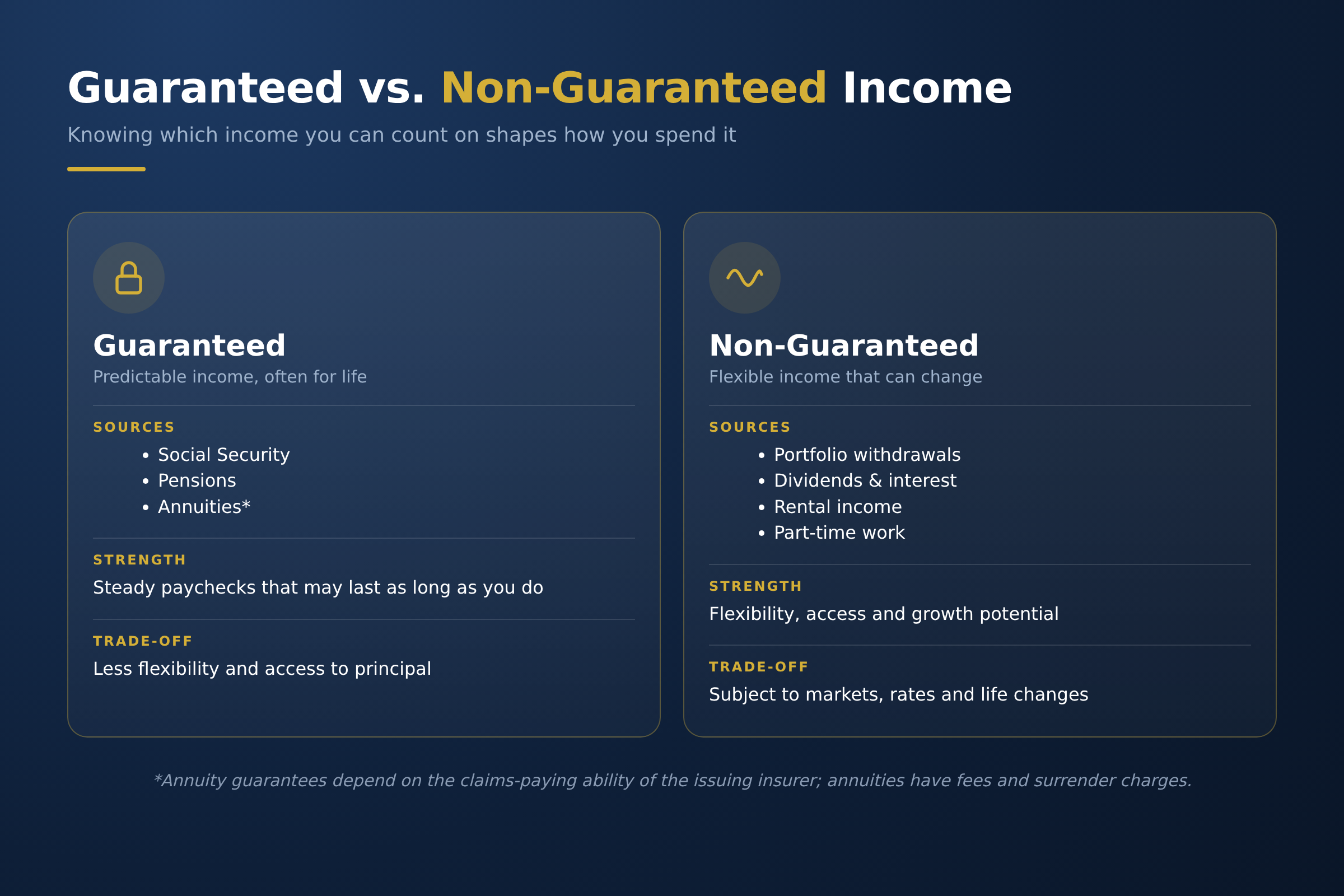
Not all retirement income is equally dependable. Understanding which sources are guaranteed and which can change may help you decide how to pay for different kinds of expenses.
Guaranteed Income Sources
- Social Security: Paid for life, with annual cost-of-living adjustments. Learn more on our Social Security Planning page.
- Pensions: Many pensions pay a set amount for life, and some offer survivor options for a spouse.
- Annuities: Certain annuities can provide lifetime income. Annuity guarantees are subject to the claims-paying ability of the issuing insurance company. Annuities also have fees and expenses, and many have surrender charges and limitations, so they may not be right for everyone.
Non-Guaranteed Income Sources
- Portfolio withdrawals: Flexible, but their value depends on market performance and how much you withdraw.
- Dividends and interest: Can provide cash flow, but payments may be reduced or change with interest rates.
- Rental income: May provide steady cash flow, but comes with vacancies, repairs and property risk.
- Part-time work or consulting: Can ease the transition into retirement, but may not last as long as you'd like.
Building an Income Floor
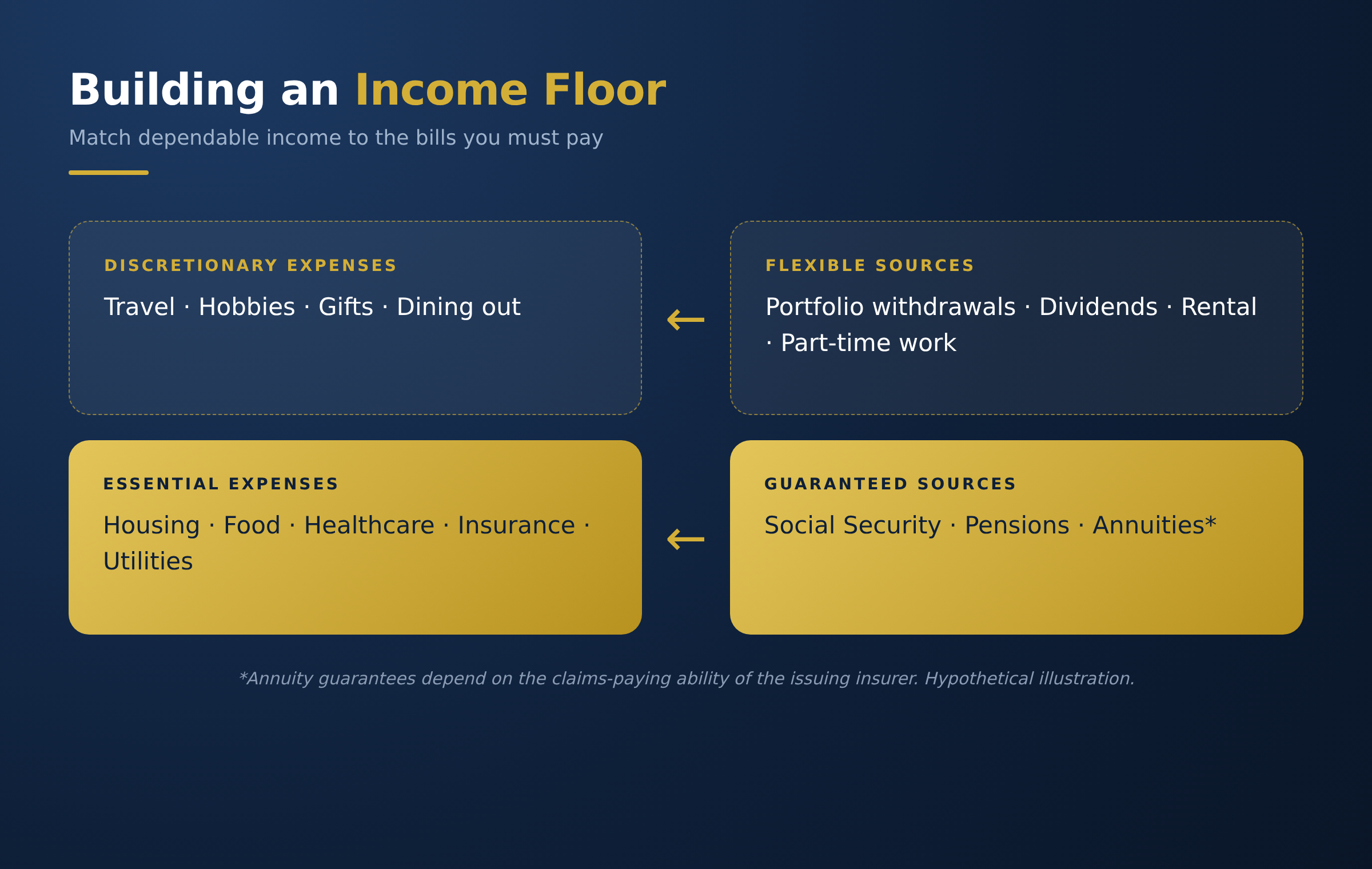
One approach many retirees consider is an "income floor." The idea is to cover essential expenses, such as housing, food, healthcare and insurance, with guaranteed income sources, and to pay for discretionary expenses, such as travel, hobbies and gifts, from more flexible sources. If markets fall, essential bills may still be covered, and discretionary spending can be adjusted.
Taxable, Tax-Deferred and Tax-Free Income
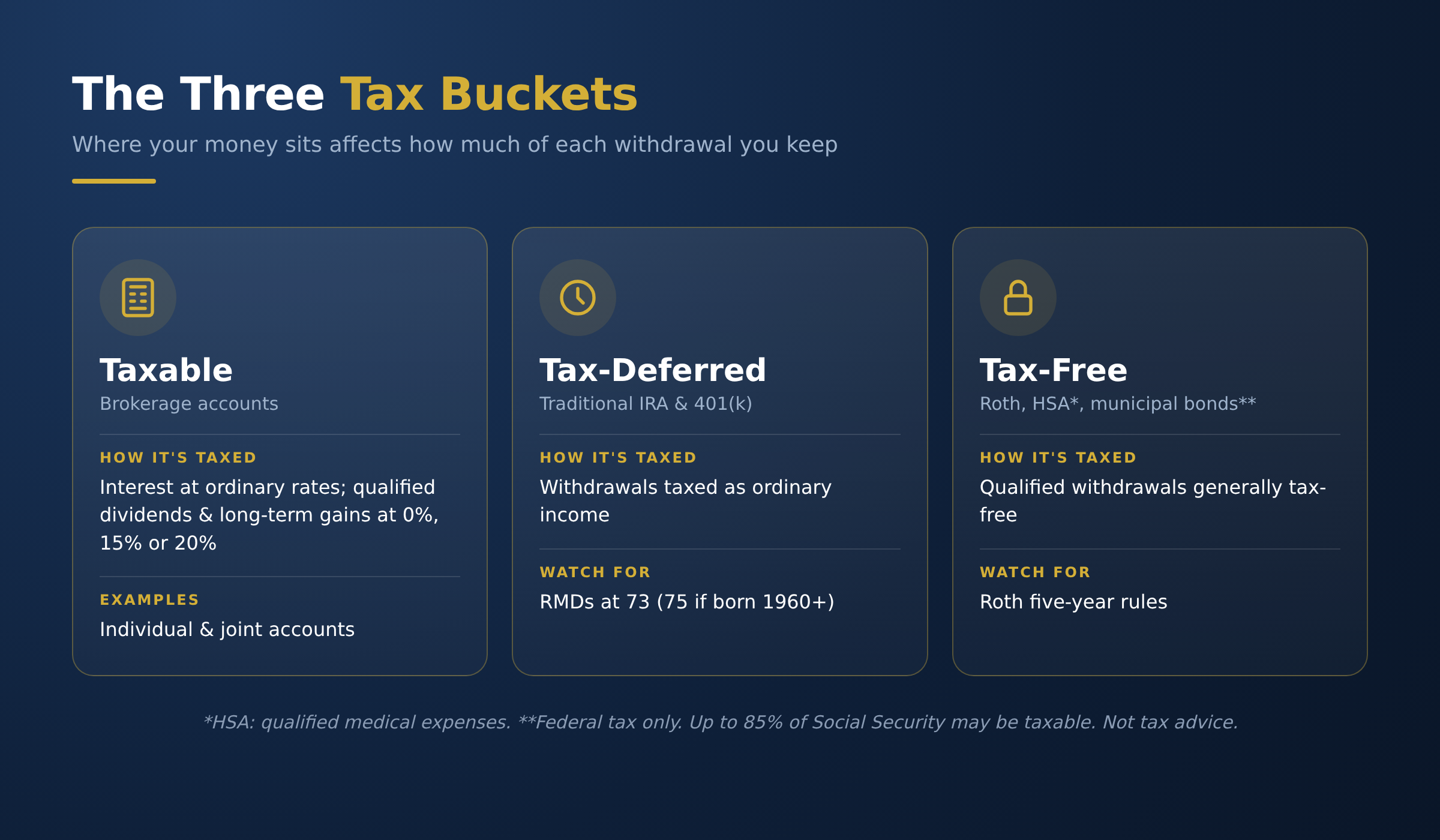
Two retirees with the same savings may keep very different amounts after taxes, depending on where their money is held and the order in which they draw from it.
Taxable Accounts
In a taxable brokerage account, interest and non-qualified dividends are generally taxed as ordinary income, while qualified dividends and long-term capital gains may receive lower rates. You generally pay tax only on gains when you sell.
Tax-Deferred Accounts
Withdrawals from traditional IRAs, 401(k)s and similar plans are generally taxed as ordinary income. Required minimum distributions (RMDs) generally begin at age 73, or age 75 for those born in 1960 or later, under the SECURE 2.0 Act.
Tax-Free Sources
- Roth IRA and Roth 401(k): Qualified withdrawals are generally tax-free.
- Health Savings Accounts (HSAs): Withdrawals for qualified medical expenses are generally tax-free.
- Municipal bond interest: Generally exempt from federal income tax, though it may be subject to state tax or the alternative minimum tax, and it is counted when determining how much of your Social Security is taxed.
How Social Security Is Taxed
Depending on your other income, up to 85% of your Social Security benefits may be subject to federal income tax. That's why your claiming decision and your withdrawals should work together.
Asset Location: Where You Hold Assets Matters
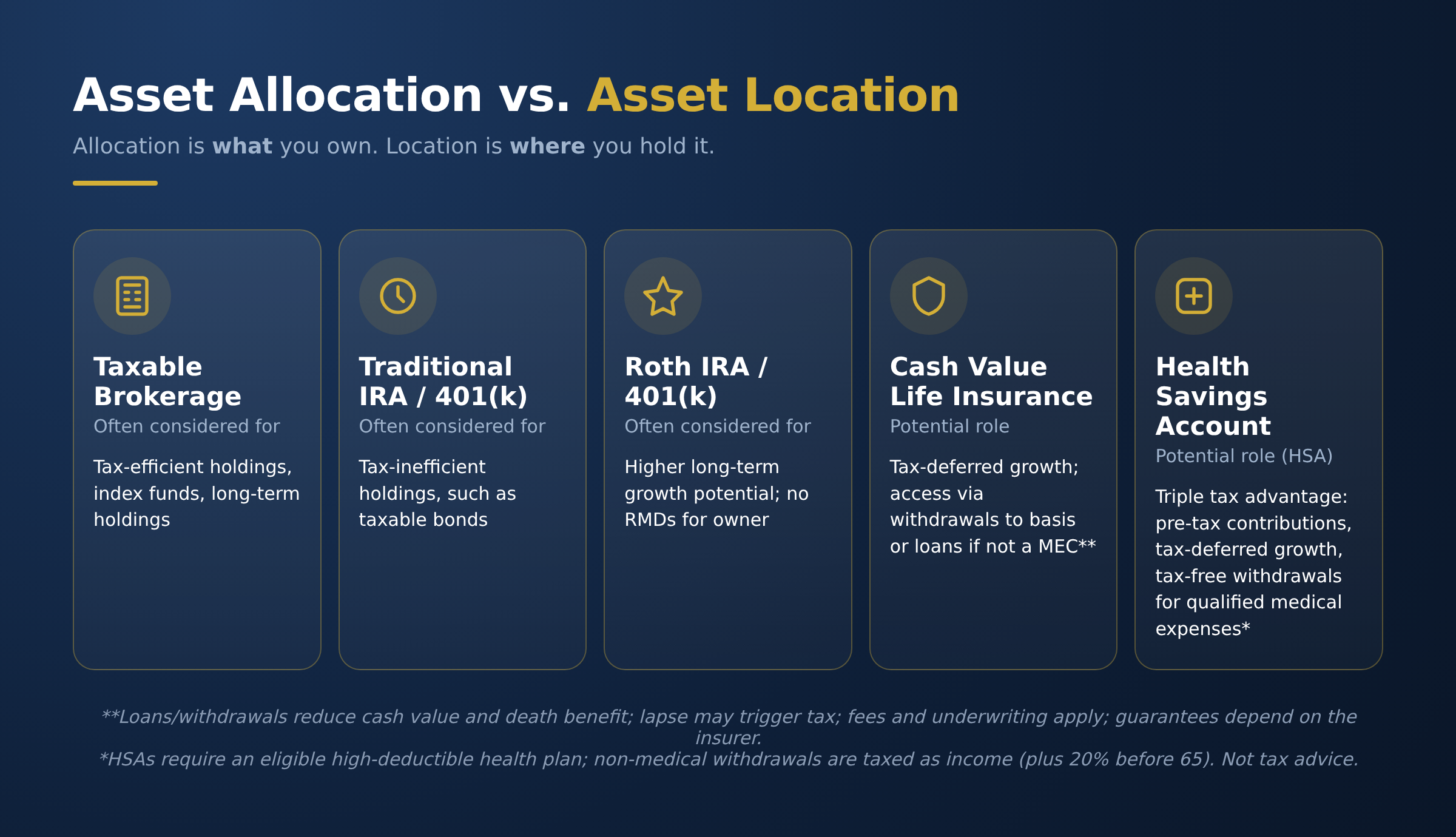
Asset allocation is how your money is divided among stocks, bonds and cash. Asset location is a different question: which type of account holds each investment. Because taxable, tax-deferred and tax-free accounts are taxed differently, thoughtful placement may help improve your after-tax income over time, without changing your overall allocation.
Taxable Brokerage Accounts
These may be a good fit for tax-efficient investments, such as broad index funds or holdings you plan to keep for the long term, since long-term gains and qualified dividends may be taxed at lower rates. Losses may also be used to offset gains.
Traditional IRA and 401(k)
Because withdrawals are taxed as ordinary income anyway, these accounts are often considered for tax-inefficient investments, such as taxable bonds or strategies that generate frequent short-term gains.
Roth IRA and Roth 401(k)
Since qualified withdrawals are generally tax-free, some investors consider holding investments with higher long-term growth potential in Roth accounts, so that more of the growth may never be taxed. Roth accounts also have no RMDs for the original owner.
Cash Value Life Insurance
Permanent life insurance with cash value can be another source of tax-advantaged funds in some situations. Cash value generally grows tax-deferred. Withdrawals are generally income-tax-free up to your basis (generally the premiums you've paid, less any prior tax-free withdrawals), and policy loans are generally not taxable while the policy stays in force, if the policy is structured properly and is not a modified endowment contract (MEC). There are important trade-offs to consider:
- Loans and withdrawals reduce the cash value and death benefit, and loans accrue interest.
- If a policy lapses or is surrendered with a loan outstanding, the gain may become taxable.
- If a policy is funded too quickly and becomes a MEC, loans and withdrawals are generally taxed on a gains-first basis and may face a 10% additional tax before age 59½.
- Policies have fees and charges, and coverage requires health underwriting.
- Guarantees are subject to the claims-paying ability of the issuing insurance company.
Life insurance is primarily for protection and may not be appropriate for everyone. We review it with you and your CPA as one part of the bigger picture.
Withdrawal Sequencing and Roth Conversions
The order in which you draw from your accounts can affect your lifetime taxes. A common starting point is to draw from taxable accounts first, then tax-deferred, then Roth, but the right order is personal and may blend sources each year to fill lower tax brackets.
What Is a Roth Conversion?
A Roth conversion moves money from a traditional IRA (or an eligible employer plan) into a Roth IRA. The pre-tax amount you convert is generally taxed as ordinary income in the year of the conversion. The 10% early-withdrawal penalty generally doesn't apply to the conversion itself. Once in the Roth, future qualified withdrawals are generally tax-free.
The "Gap Years" Opportunity
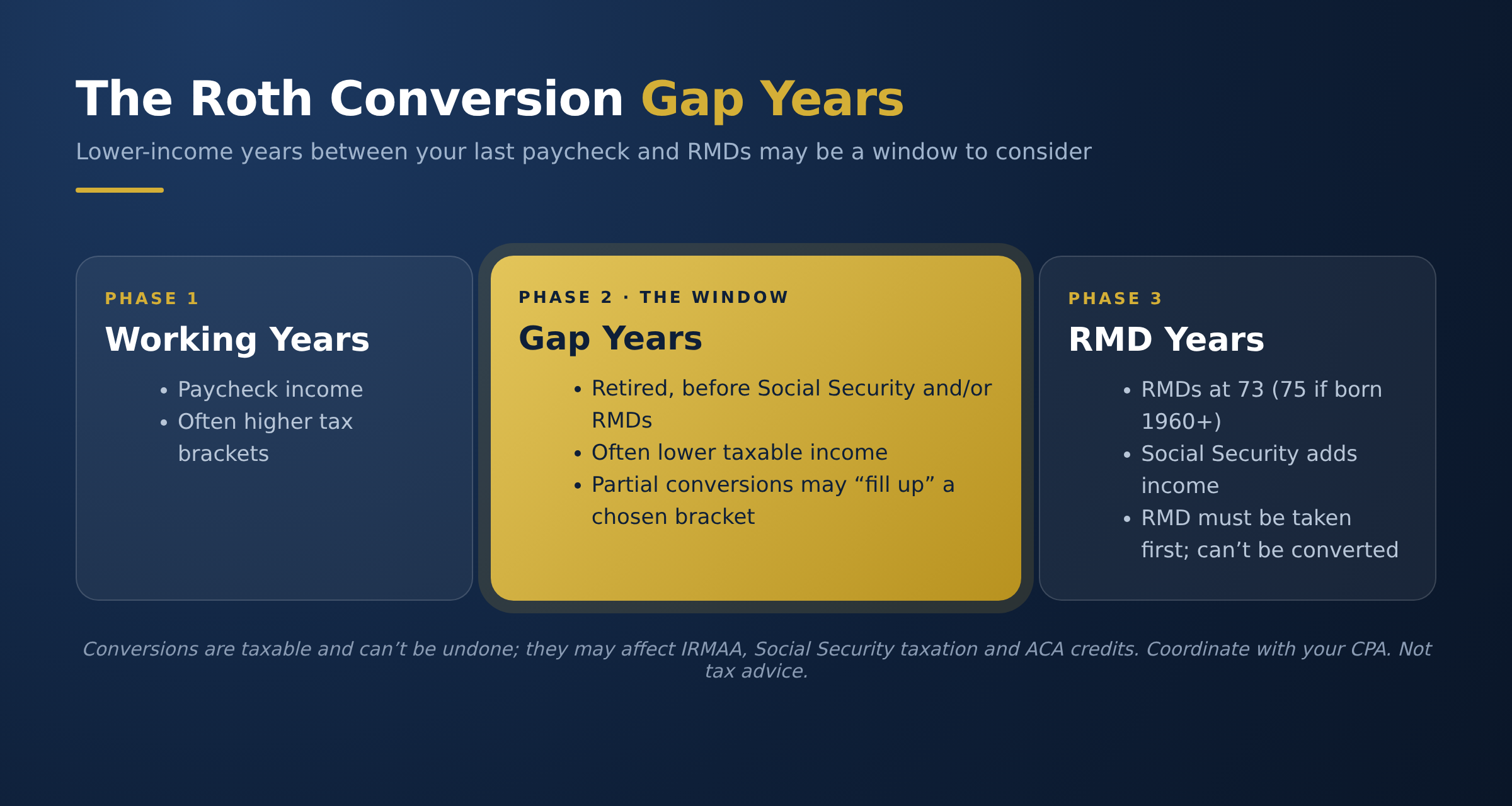
For many people, the years between retiring and starting Social Security and required minimum distributions (RMDs) are their lowest-income years. With no paycheck and before RMDs begin at age 73 (or 75 for those born in 1960 or later), these gap years may be a window to consider converting at lower tax rates than you might face later.
Filling Up a Tax Bracket
Rather than converting everything at once, some people consider partial conversions spread over several years, converting just enough each year to "fill up" a chosen tax bracket without moving into a higher one. This approach may help manage the total tax cost and keep income below other important thresholds.
Reasons Some People Consider a Conversion
- Lower future RMDs: Smaller traditional IRA balances mean smaller required distributions later.
- Tax diversification: Having both taxable and tax-free accounts may give you more flexibility to manage income each year.
- Tax-free income later: Qualified Roth withdrawals don't add to your taxable income.
- No lifetime RMDs: Roth IRAs don't require distributions during the original owner's lifetime.
- Heirs: Under the SECURE Act, most non-spouse beneficiaries must empty an inherited IRA within 10 years. Inherited traditional IRA withdrawals are generally taxable to heirs, while qualified inherited Roth withdrawals are generally tax-free.
- The surviving spouse: After the year a spouse passes away, the survivor generally files as a single taxpayer, with narrower tax brackets, often while keeping much of the same income. Converting while both spouses are living may help reduce this future tax burden.
Trade-Offs and Risks
- Medicare premiums: Conversion income may raise your Medicare Part B and Part D premiums (IRMAA) two years later.
- Social Security taxes: Added income may increase how much of your Social Security benefit is taxed.
- ACA premium credits: For retirees under 65 buying coverage through the Health Insurance Marketplace, conversion income may reduce premium tax credits.
- Paying the tax: Paying the conversion tax from non-IRA funds generally keeps more money growing in the Roth. Withholding tax from the conversion reduces the amount converted, and withholding before age 59½ may be subject to the 10% penalty.
- No undo: Since 2018, a Roth conversion can no longer be recharacterized (reversed), so the decision is final once made.
- Five-year rule: Each conversion has its own five-year period. If you're under 59½, withdrawing converted amounts within five years may trigger the 10% penalty.
- State taxes: Texas has no state income tax, but if you may move to a state that does, the timing of conversions may matter.
Conversions After RMDs Begin
Once RMDs begin, you can still convert, but the year's RMD must be taken first, and the RMD itself can't be converted to a Roth.
Questions to Consider
- What tax bracket am I in now, and what bracket might I be in later?
- How many gap years do I have before Social Security and RMDs?
- Can I pay the conversion tax from savings outside my IRA?
- How would added income affect my Medicare premiums, Social Security taxes or ACA credits?
- Will I need these funds within five years?
- Do I plan to leave IRA assets to heirs, and what are their tax situations?
A Roth conversion isn't right for everyone. We help you weigh the trade-offs and coordinate any conversion with your CPA.
Income and Medicare Premiums
Medicare Part B and Part D premiums may rise when your income exceeds certain levels, a surcharge known as IRMAA. It's based on your tax return from two years earlier, so large withdrawals, conversions or sales can affect premiums later.
Planning for Retirement Risks
- Longevity: Your income may need to last 30 years or more.
- Sequence of returns: Market declines early in retirement, while you're withdrawing, can have a lasting effect on your savings.
- Inflation: Rising prices reduce purchasing power over time.
- Healthcare costs: Medicare doesn't cover everything, and long-term care can be expensive.
A well-built income plan considers each of these risks.
Health Savings Accounts: A Triple Tax Advantage for Retirement
Healthcare is one of the larger expenses many retirees face. Fidelity's 2026 Retiree Health Care Cost Estimate projects that a 65-year-old retiring in 2026 may spend an average of $185,500 on healthcare and medical expenses throughout retirement, not including long-term care. For those who are eligible, a Health Savings Account (HSA) may be one of the most tax-efficient ways to prepare for those costs. JTL Wealth Partners does not offer HSAs, but we help clients consider how an HSA may fit into their retirement plan.
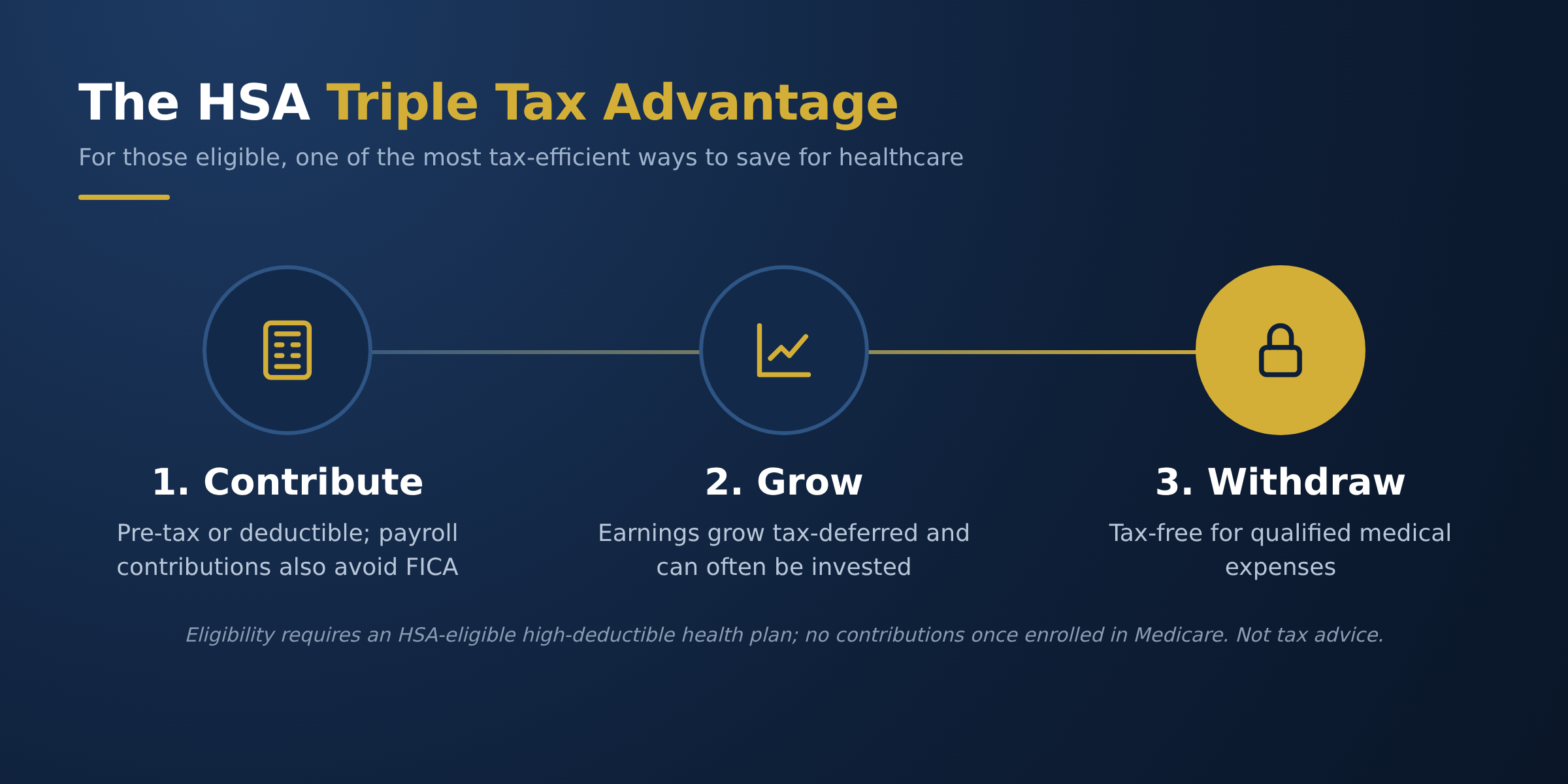
The Triple Tax Advantage
- Tax-deductible contributions: Contributions you make are generally deductible, and contributions made through an employer's cafeteria plan by payroll deduction are generally excluded from income and from Social Security and Medicare (FICA) taxes.
- Tax-deferred growth: Interest and investment earnings in the account generally grow without current tax.
- Tax-free withdrawals: Withdrawals for qualified medical expenses are generally tax-free.
Who Can Contribute
To contribute, you generally must be covered by an HSA-eligible high-deductible health plan (HDHP), have no other disqualifying health coverage and not be claimed as a dependent. For 2026, the contribution limits are $4,400 for self-only coverage and $8,750 for family coverage, plus an additional $1,000 catch-up contribution if you're 55 or older. Once you enroll in Medicare, you can no longer contribute. Because Medicare Part A coverage can be retroactive for up to six months when you enroll after 65, you may want to consider stopping contributions about six months before you apply to avoid excess contributions. HSAs aren't right for everyone, and an HDHP may not suit every household's healthcare needs.
Why HSAs Can Be Valuable in Retirement
- No "use it or lose it": Unused funds roll over from year to year.
- Portable: You own the account and keep it if you change jobs or retire.
- Can be invested: Many HSA providers allow you to invest your balance for long-term growth. Investments involve risk, including possible loss of principal.
- Reimburse yourself later: You may withdraw funds tax-free in a later year to reimburse yourself for qualified medical expenses incurred after the HSA was established, as long as you keep records. There's currently no deadline for doing so.
- After age 65: Withdrawals for non-medical expenses are taxed as ordinary income but are no longer subject to the 20% additional tax. Medicare Part B, Part D and Medicare Advantage premiums can be qualified expenses, but Medigap premiums are not.
- Beneficiaries: A spouse named as beneficiary can treat the HSA as their own. For other beneficiaries, the account generally stops being an HSA, and its value becomes taxable income in the year of death.
- State taxes: A few states, including California and New Jersey, don't follow the federal HSA tax treatment. Texas has no state income tax.
A Common Mistake: Leaving Your HSA Uninvested
One of the most common mistakes we see is an HSA balance sitting in cash year after year. Many HSA providers keep contributions in a cash or savings option by default, and some require a minimum cash balance before you can invest the rest. If you don't plan to spend the money soon, consider whether investing part of it for the long term fits your goals, so it has the potential to grow toward future healthcare costs. Investments involve risk, including possible loss of principal.
HSA vs. Health Care FSA
Health care flexible spending accounts (FSAs) also use pre-tax dollars for medical expenses, but they work very differently over the long term.
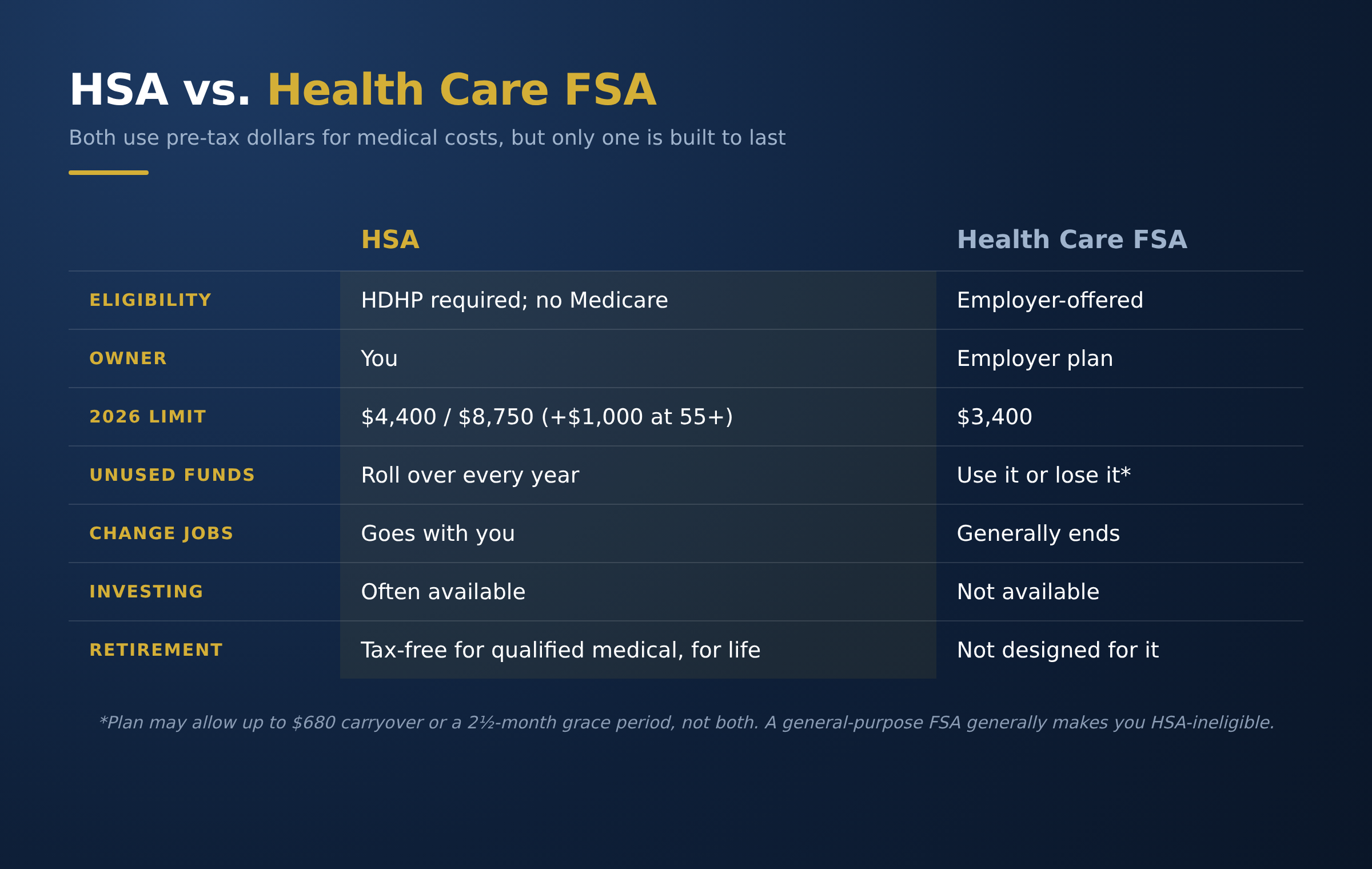
| Feature | Health Savings Account (HSA) | Health Care FSA |
|---|---|---|
| Eligibility | Must be covered by an HSA-eligible high-deductible health plan and not enrolled in Medicare | Offered through an employer; no HDHP required |
| Ownership | You own the account | Employer-sponsored plan |
| 2026 contribution limit | $4,400 self-only; $8,750 family; plus $1,000 catch-up at 55+ | $3,400 per employee |
| Unused funds | Roll over every year | Generally "use it or lose it"; a plan may allow a carryover of up to $680 into 2027 or a grace period of up to 2½ months, but not both |
| Changing jobs | Portable; stays with you | Generally ends when you leave the employer (COBRA may apply) |
| Investing | Often available | Not available |
| Use in retirement | Can pay qualified medical expenses and certain Medicare premiums tax-free for life | Not designed for retirement savings |
| Using both | A general-purpose health FSA generally makes you ineligible to contribute to an HSA | A limited-purpose FSA (dental and vision) can generally be paired with an HSA |
We help clients in Plano, Southlake and across DFW consider how an HSA may fit alongside their other tax buckets, with input from their CPA and benefits administrator.
Retirement Income Facts Many People Don't Know
A few lesser-known rules may make a real difference in how much income you keep.
Did you know you may give from your IRA without the income counting?
Starting at age 70½, you may make a qualified charitable distribution (QCD) directly from your IRA to an eligible charity. For 2026, you may give up to $111,000, and the amount isn't included in your taxable income. QCDs can also count toward your RMD.
Did you know some long-term capital gains may be taxed at 0%?
For 2026, long-term capital gains and qualified dividends may be taxed at 0% when taxable income is up to $49,450 for single filers or $98,900 for married couples filing jointly. Lower-income years may be an opportunity to realize gains.
Did you know the penalty for a missed RMD was reduced?
Under SECURE 2.0, the excise tax for a missed RMD fell from 50% to 25% of the shortfall, and it may drop to 10% if the missed amount is withdrawn and reported within the correction window, generally two years.
Did you know RMDs may start later for some people?
RMDs generally begin at age 73, and for those born in 1960 or later, at age 75. An IRA owner's first RMD may be delayed until April 1 of the following year, but that can mean two taxable RMDs in one year.
Did you know Roth accounts have more than one five-year rule?
For Roth IRA earnings to be withdrawn tax-free, you generally must be 59½ and five years must have passed since your first Roth IRA contribution. Each Roth conversion also has its own five-year period for the 10% early-withdrawal penalty if you're under 59½.
Did you know Medicare looks back two years at your income?
For 2026, Medicare's IRMAA surcharge begins when 2024 income exceeds $109,000 for individuals or $218,000 for joint filers. If your income dropped because of a life-changing event such as retirement, you may request a reduction using Form SSA-44.
Did you know Roth accounts don't have RMDs for the original owner?
Roth IRAs have no RMDs during the owner's lifetime, and starting in 2024, Roth 401(k)s don't either. This may give you more control over your taxable income later in retirement.
Did you know a Roth conversion can't be undone?
Before 2018, you could reverse, or "recharacterize," a Roth conversion. Under the Tax Cuts and Jobs Act, conversions made in 2018 or later can't be recharacterized, so it may be worth reviewing projections carefully before converting.
Did you know you can't convert your RMD?
In a year when an RMD is required, the first dollars you withdraw count toward your RMD, and the RMD itself can't be rolled over or converted to a Roth. You'd generally take the full RMD first, then convert additional amounts.
For clients in Plano, Southlake and beyond, we look at these rules together so each part of your income plan works with the others.
How JTL Wealth Partners Helps
As an independent firm, we follow a clear process:
- Discover: We learn about your goals, lifestyle and retirement timeline.
- Gather: We review your savings, pensions, Social Security estimates, insurance and other income sources.
- Analyze: We separate essential and discretionary expenses and compare income and withdrawal scenarios, including taxes and Medicare premiums.
- Plan: We build a retirement income plan that shows where your income may come from and in what order.
- Review: We revisit your plan as laws, markets and your life change.
Who We Work With
We work with pre-retirees and retirees in Plano, Southlake and across the Dallas-Fort Worth area who want a clear plan for turning savings into income. We also work with clients in other states through virtual meetings. Our team, including Chris Mankoff, CFP®, Jimmy Lee and Joseph Rosio, CPA, is here to help.
Frequently Asked Questions
What is retirement income planning?
It's the process of deciding where your retirement income will come from, how dependable each source is, how it's taxed and in what order you'll use your accounts.
Should I buy an annuity?
It depends. Annuities may help create guaranteed lifetime income, but they have fees, surrender charges and limitations, and guarantees depend on the issuing insurer. We help you weigh whether one fits your plan.
Which account should I withdraw from first?
There's no one-size-fits-all answer. The best order depends on your tax bracket, RMDs, Social Security timing and Medicare premiums.
When do required minimum distributions start?
Generally at age 73, or 75 if you were born in 1960 or later.
Is a Roth conversion right for me?
It depends. A conversion may make sense to consider if you expect higher tax rates later, have lower-income gap years, can pay the tax from non-IRA savings or want to leave tax-free assets to heirs. It may be less attractive if it pushes you into a higher bracket, raises Medicare premiums or ACA costs, or if you'll need the money soon. Because conversions can't be undone, we review the numbers with you and your CPA before you decide.
What is the difference between asset allocation and asset location?
Asset allocation is your mix of investments. Asset location is which accounts hold those investments, which may affect how much you keep after taxes.
What's the difference between an HSA and an FSA?
An HSA requires an eligible high-deductible health plan. You own it, unused funds roll over, it can often be invested, and it can be used for qualified medical expenses in retirement. A health care FSA is offered by an employer, is generally "use it or lose it" (with a limited carryover or grace period if your plan allows), and usually ends when you leave your job. A general-purpose FSA generally makes you ineligible to contribute to an HSA.
Do you work with clients outside Plano and Southlake?
Yes. We serve clients across DFW and work with clients in other states through virtual meetings.
Build Your Retirement Income Plan
A conversation is the best place to start. Call us at 855-949-4400 or schedule a time that works for you.
Book a Complimentary Discovery Meeting
JTL Wealth Partners | 5055 W Park Blvd, Suite 400, Plano, TX 75093 | 855-949-4400
JTL Wealth Partners and LPL Financial do not provide tax or legal advice. Please consult your tax professional or attorney regarding your specific situation. Annuities and life insurance are long-term products; guarantees are based on the claims-paying ability of the issuing insurance company. Annuities and cash value life insurance contain fees, expenses and surrender charges, and life insurance requires underwriting. Policy loans and withdrawals reduce cash value and death benefit and may cause the policy to lapse, which may result in tax consequences. No strategy assures success or protects against loss. This material is for general information only and is not intended to provide specific advice or recommendations for any individual.